Build the Routine Before the Game: A Mental Performance System for Baseball Players
Baseball is a game of routine. From a pitcher stepping onto the mound to a hitter digging into the box, the best players rely on repeatable processes that allow them to perform under pressure. But many athletes think of their routine as something that starts in the batter’s box or on the field. But here is the secret, elite performance actually begins the day before the game, sometimes even earlier.
A strong mental and physical routine builds confidence, reduces anxiety, and allows athletes to step onto the field prepared instead of reactive. When athletes control the controllables, they free their minds to compete. No matter where they play, it feels like home field. Here is a simple routine framework baseball players can use to prepare for game day. At the bottom of this post I will also include a pre-game check list that you can use to make sure you are prepared for your next game.
The Routine Starts the Day Before
Preparation begins long before the first pitch. I like to tell athletes that the entire day prior from wake up is when your routine begins. If you have to go with the bare minimums then the evening before a game is an opportunity to prepare both the body and the mind for performance. This post is going to prepare you for success starting with the night before.
Visualization of the Upcoming Game
Before bed, athletes can spend a few minutes visualizing the upcoming game while in a relaxed state. Visualization is not just imagining success. It is mentally rehearsing situations so the brain becomes familiar with them before they happen. Theres a lot of science showing that the brain and body can make neural connections through visualization, it can also bring familiarity to your mind as far as what to expect which can keep anxiety levels down.
Players can visualize:
Seeing the ball clearly at the plate
Making strong defensive plays
Running clean base paths
Responding confidently after mistakes
The brain processes vivid imagery in ways similar to real experience. When the moment arrives, it feels familiar instead of overwhelming. The key is “vivid” imagery. When you use visualization techniques you want to try and build out your environment as vividly as possible, meaning with as many of your senses as possible. Smell the fresh cut grass, see the field, feel the texture of the grip on your bat or your glove, etc.
Nutrition, Hydration, and Fueling Recovery
Performance tomorrow starts with how the body is treated today. Making sure that you hydrate and fuel properly the day before will pay dividends on game-day. The day before a big game is not the time to try out a new burrito truck or to binge on junk food. It is the time to eat healthy to fuel your body. You can’t drink water and make up a streak of dehydration on game-day. You need to prepare ahead of time.
Athletes should focus on:
Drinking adequate water throughout the day prior
Eating balanced meals with carbohydrates, protein, and healthy fats
Avoiding excessive junk food or late-night sugar spikes
Avoid eating a huge meal right before bed which can impact sleep quality
Proper fueling supports muscle recovery, cognitive function, and sustained energy during the game. Think of it as filling your gas tank up the day before a long trip. You want the fuel available to reach your destination.
Check Your Equipment
This may seem simple, but it has an important psychological effect. It is about calming your mind so you can sleep and removing variables of worry and distraction while you are trying to relax the night prior. Additionally, on game day it gives added confidence that your equipment is reading and in working order.
Before the game, athletes should check:
Glove
Cleats
Bat
Uniform
Helmet
Any personal gear
Preparation creates confidence. When players know everything is ready, their mind can focus entirely on preparing for the game and come game-day, there is confidence in knowing that your equipment is in working order. (This is particularly important for catchers.)
This is a routine that I continued throughout my years playing hockey (even now in adult league) and in competing in triathlons. The night prior I check all my equipment in order. If I am checking my hockey equipment then I start with my helmet and work down to my skates. For triathlons I work in order of events starting with my head working down to my feet for each event. It is systematic, it is the same every time, and I don’t feel a need to get up out of bed to check one more thing before I can truly rest.
Build a Consistent Sleep Routine
Sleep is one of the most powerful performance tools athletes have. It can determine if you show up at 100% or 50%. While some things can impact your sleep (like a neighbor’s dog barking or having a newborn baby), there are a lot of things within your control that can positively influence your sleep and recovery.
A consistent sleep routine helps the body enter recovery mode and supports:
Reaction time
Decision-making
Emotional regulation
Physical recovery
Alertness/Focus
A simple routine might include:
Turning off screens 1-3 hours before bed (yes, I said hours)
Cutting out caffeine after noon
Blacking out your room with curtains and covering light sources with tape (on computers or printers)
Dropping your room temperature (even 2 degrees has been shown to positively impact sleep)
Stretching or light breathing exercises
Reviewing positive visualizations of game day while in a relaxed and composed state
When athletes sleep well, they show up ready to compete. Control the variables that are within your control and maximize your sleep and recovery.
Game Day: Controlling Arousal and Focus
Game day often brings excitement and nerves. Both are normal. Feeling nervous is okay, it means that what you are about to do is important to you. It is alright to recognize the feelings, acknowledge them, and then let them go while you continue to move towards your goal. The goal is not to eliminate nerves but to manage arousal levels so athletes stay in their optimal performance zone.
Two powerful tools are breathing and visualization. Both can be used in almost any situation and both have the ability to raise and lower arousal levels to help you get your focus, energy, and attention where they need to be.
Breathing to Stay in Control
Slow, controlled breathing helps regulate the nervous system. The exhale is what modulates your relaxation and your inhale is what modulates your arousal. By learning to control the length, power, and tempo of your breathing, you can ultimately control your level of activation. We aren’t going to go into box breathing or anything else, we are going to keep this as simple as possible while still being effective.
Inhale slowly through the nose
Hold briefly
Exhale longer than the inhale
This activates the parasympathetic nervous system (the system responsible for resting), calming the body and sharpening focus.
Breathing can be used:
Before the game
Between innings
Before stepping into the batter’s box
After a mistake
One simple reminder that I want you to remember is this. If you are losing control, you feel that your anxiety is driving and you are just holding on for deer life, breathe. Remind yourself that as long as you are breathing you are alive and as long as you are alive you have control.
Visualization of Game Situations
Before warmups or during quiet moments, athletes can mentally rehearse likely scenarios. As mentioned earlier, there is a lot of research behind the benefits of vivid visualization techniques for developing neural connections and creating familiarity. I like to recommend my athletes use visualization to see a play go perfectly and then what their contingency plans are when things go wrong. Here’s a few other ways you can use visualization for position specific preparation.
A shortstop might visualize:
Fielding a routine ground ball
Turning a double play
Charging a slow roller
Blocking an odd bounce with their body and recovering the ball to make the play
A hitter might visualize:
Seeing the ball early
Staying relaxed in the box
Driving the ball into the gap
Visualization becomes mental rehearsals helps the brain build a map for performance. Visualization offers you repetitions and familiarity.
The Importance of a Quality Warm-Up
The warm-up is more than just getting loose. Your warm-up is the transition from preparation to competition. It is a bridge that should be firmly rooted in routine that prepares you physically and mentally.
A quality warm-up should include:
Dynamic movement
Throwing progression
Position-specific drills
A few moments of mental focus
This is the moment athletes shift from thinking about the day to preparing to compete. A good warm-up flips your switch into game-mode. Some players have custom playlists, others read a quote, some close their eyes and have a set piece of imagery that switches their focus in to game-mode. Find what works for you. For your next couple games, write out everything you do, see what works and what doesn’t.
Preparing for the Unexpected
Baseball is a game of failure, setbacks, and unpredictability. But, that also means that it is a game of triumph, overcoming obstacles, and creativity. Routine cannot eliminate mistakes, but it can prepare athletes to respond to them. Here are a few tips for before, during, and after the game.
Before the game, players should mentally rehearse responses to setbacks:
Striking out
Making a defensive error
Giving up a hit or run
Instead of dwelling on mistakes, athletes can practice planned responses:
Take one breath
Reset focus with a physical movement (such as tapping your foot or throwing an imaginary ball away)
Move to the next play, return to the present and use all your senses to return you to the present
The best players are not the ones who avoid mistakes, the best players learn from them and recover from setbacks. After the game take time to conduct an after action review. Think about the plays you were involved in, how did you react, how should you have reacted? Take time to write out in as much detail as possible how you should have responded to get the desired outcome. This is a great exercise for developing that response for future situations.
Routine Creates Confidence
When athletes follow a consistent routine, they remove uncertainty from performance. They know they prepared. They are confident that they are ready. When pressure rises, routine becomes an anchor that brings them back to the present moment. Routines make every field a home field because you are in control of your set-up, warm-up, and performance. Every controllable variable is accounted for and you have contingencies for any variable out of your control.
Confidence is not just a feeling. Confidence is built through preparation and preparation starts long before the first pitch.
To make things easier, I have created a routine checklist that will help you develop and refind your routine for the upcoming baseball season. There are no strings attached to these downloads, they are yours to use to build confidence and increase your performance.
If you are interested in learning more about developing your routines and taking your performance to the next level, use one of the contact forms on the site or sign up for a free 30-minute consultation. I work with athletes in person and over the phone/zoom and I would be glad to help you reach your performance goals.
~ Coach Tyler
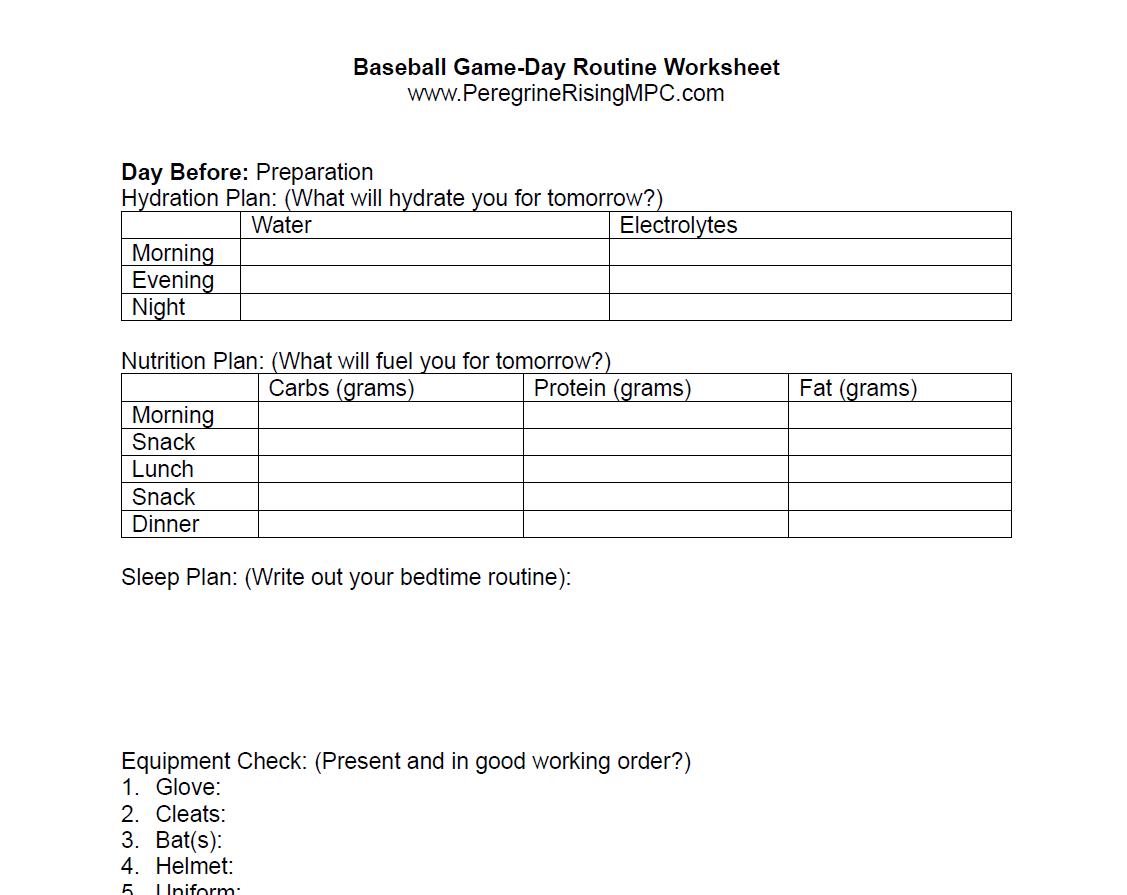
This worksheet is designed for baseball/softball players to use to develop their routines for game day. The goal is to have a routine that includes the entire previous day and that can be used to increase focus, performance, and prepration.