The Best Kept Performance Enhancing Secret
Every athlete wants an edge. There’s always talk about performance enhancing, habits, diets, programs, supplements, everything. But there is one performance enhancer that either people forget, or they don’t care enough about, even though there’s a wealth of knowledge showing that it is one of the GREATEST performance enhancing habits that an athlete can have. You don’t need to spend hundreds or thousands of dollars to enhance your performance, you need to develop the right habits and put the same effort into your recovery that you do into developing your performance.
Sleep isn't passive recovery, it's active performance training. While you're asleep, your brain is consolidating motor learning, your muscles are repairing damaged tissue, hormones are regulating growth and recovery, and your nervous system is preparing for another day of training (Fullagar et al., 2023; Walsh et al., 2021). In other words, you’re enhancing your performance while you’re asleep.
You cannot outwork poor sleep. If you consistently sacrifice sleep, you're also sacrificing reaction time, decision-making, emotional control, learning, recovery, and long-term athletic development (Vitale et al., 2019; Walsh et al., 2021). Staying up late to stay ‘in the know’ through social media or video games is impacting your performance for the following days (that’s right… plural, days).
The good news is that great sleep is trainable. Just like strength, nutrition, and mental skills, sleep improves through consistent habits. It might seem like a mountain to climb, but developing a few of these habits week by week will pay dividends in your sleep quality, quantity, and in your overall competitive performance.
Why Sleep Matters for Athletic Performance… Is It Really That Important?
Sleep influences nearly every aspect of athletic performance, including reaction time, concentration, emotional regulation, skill acquisition, recovery, immune function, and resilience (Fullagar et al., 2023; Vitale et al., 2019). Elite athletes often experience poorer sleep than the general population because of early morning training, late-night competitions, travel, academic demands, and pre-competition anxiety (Walsh et al., 2021; Vlahoyiannis et al., 2021). Unfortunately, these same athletes depend on quality sleep more than most because training adaptations occur during recovery rather than during the workout itself.
Training provides the stimulus. Sleep creates the adaptation.
If you review your pre-sleep habits, we can start to pinpoint the culprit stealing your recovery. Sometimes the smallest actions, that seem unimportant, or might even seem beneficial in helping to decrease stress (such as using doom scrolling as a distraction - see this post), can have a negative influence on your sleep and recovery. Funny enough, the things we are using to try and decrease stress might actually be hindering our sleep, decreasing our body’s natural ability to mitigate the effects of stress on our nervous system and ultimatelly creating a doom spiral of… stress related issues.
Build a Consistent Sleep Schedule
Let’s start with the basics, your body thrives on routine. Going to bed and waking up at approximately the same time each day helps regulate your circadian rhythm, allowing you to fall asleep more easily and obtain higher-quality sleep (Walsh et al., 2021). Consistency is more important than perfection.
If a late competition or travel disrupts your schedule, return to your normal bedtime and wake time as soon as possible rather than trying to "catch up" by sleeping excessively late. Your body naturally gets into a rhythm which is why when you travel to different time zones you feet “jet lagged”, which is a fancy way of saying that your body needs to reset its circadian rhythm.
Set your routine by establishing your bed and wake times first. Be consistent. Shoot for 8-10 hours of time in bed. That is head on pillow and eyes closed, not hand holding phone and streaming, scrolling, or gaming… I will get into that more in a little bit. Get out a piece of paper and write your time in bed like this:
Go to sleep: 9 pm
Wake up: 6 am
We are going to use this bracket to reverse plan your timeline off of. This is the simplest step to start with, consistency. This step alone will create an observable benefit from a sleep performance standpoint.
Create an Environment That Promotes Recovery
Your bedroom should communicate one message to your brain:
"It's time to sleep."
Research consistently recommends maintaining a cool, dark, and quiet sleep environment to improve sleep quality and reduce nighttime awakenings (Vitale et al., 2019; Walsh et al., 2021). You need to be the master of your bedroom and set yourself up for success. Just like putting your running shoes and headphones by the door makes it for your body to go out for that morning run, having a room set up to positively influence your sleep will pay off in sleep, recovery, and consistency.
Small changes such as blackout curtains, limiting noise, or lowering the room temperature can have meaningful effects on recovery. Even things as simple as changing your sheets or what you wear to bed can change your sleep performance. Don’t shotgun blast it and change everything at once, find one variable and set it for a week to see what changes in your sleep performance.
For the first week try lowering your room temperature by a few degrees. You can set a temperature schedule on most thermostats. The second week add blackout curtains. The third week find noise makers in your room and remove them. Shut down electronics with fans, cover LED lights with black electrical tape. 1% differences add up over time.
Put Electronics Away Before Bed
One of the greatest threats to quality sleep is the glowing screen in your hand or hanging on your wall. Phones, tablets, televisions, and computers stimulate the brain precisely when it should be winding down. There is almost a pavlovian response in your brain when you pick up your phone. It get stimulated and it is waiting to recieve feedback and awards through doomscrolling, streaming, or video games.
In addition to brain stimulation, light emitted from electronic devices can delay melatonin release and make it more difficult to fall asleep (Vitale et al., 2019). Melatonin is a naturally occurring hormone in the brain that regulates your body’s circadian rhythm, also known as your sleep-wake cycle.
Aim to stop using electronics at least 60 minutes before bedtime. That is 60 minutes before you get into bed, not 60 minutes before you fall asleep. You might be asking, “what should I do with my evening if I can’t find the latest news about (insert topic, person, or cat video here)?”
Meditation, mindfulness, breathing exercises, journaling, LIGHT stretching, reading a physical book with pages (not a Kindle or the like). and thinking about things you are grateful for from the previous day have all been demonstrated to benefit your sleep cycle. Change your habits, change your life.
Watch What, and When, You Eat and Drink
Nutrition doesn't stop after dinner. Heavy meals immediately before bed may interfere with sleep quality, while caffeine consumed later in the day may remain active for several hours depending on the individual (Vitale et al., 2019).
Many athletes underestimate how long energy drinks, coffee, or pre-workout supplements remain in their system. If you regularly consume caffeine before afternoon practices, it may still be affecting your sleep that evening. The halflife of caffeine in healthy adults is approximately 5 hours, which means that after 5 hours, half of the amount of consumed caffeine remains in your system. For an energy drink, you might be looking at 15-20+ hours depending on caffeine content (Institute of Medicine Committee on Military Nutrition Research, 2001).
Hydration remains important throughout the day, but avoid excessive fluid intake immediately before bed to reduce nighttime awakenings. A glass of water with dinner is great, but don’t look at your water intake tracker and pound a half gallon immediately before going to bed. Try to limit water intake after dinner time.
Establish a Pre-Sleep Routine
Championship performances don't happen by accident. If you have been reading my posts then you know that I consistently push routines. You could almost say that I make a… routine…. out of it. But, just like performance isn’t an accident, but it is built through consistency in the gym and in training, sleep performance and quality doesn’t happen by accident.
Develop a consistent bedtime routine that signals your brain it's time to transition from performance mode into recovery mode. Think of this as your pre-sleep-performance routine. This routine might include light stretching, reading, prayer, deep breathing, gratitude journaling, or preparing equipment for the following day. One of my favorite things is to check my list of to-do’s for the next day and make sure I won’t have any surprises. I also use a physical list for my daily to-do’s that allows me to check it and confirm that everything is done. It gives me peace of mind and limits my brain from racing.
Repeated bedtime routines create behavioral cues that help the body fall asleep more efficiently (Walsh et al., 2021). At the bottom of this post I will go over a routine tracker that I put together for athletes and you can use as well (free).
Get Morning Sunlight
One of the simplest ways to improve sleep actually happens after waking up and has a major impact on your circadian rhythm. Exposure to natural sunlight shortly after waking helps regulate the body's circadian rhythm, improving alertness during the day while making it easier to become sleepy at night (Walsh et al., 2021).
Even 10–20 minutes outdoors each morning can help strengthen this rhythm. Take the dog for a walk, go for a light job, or just go outside to stretch and enjoy the sunlight that isn’t coming through windows. Your body will appreciate it and you will realize that you feel more energized throughout your morning, even without the energy drink.
Exercise Earlier When Possible
Regular physical activity generally improves sleep quality. However, very intense exercise immediately before bedtime may delay sleep onset in some athletes because of increased physiological arousal (Vitale et al., 2019). When late practices are unavoidable, include an intentional cooldown consisting of hydration, stretching, and relaxation exercises to facilitate recovery.
Physical activity activates your sympathetic nervous system (fight or flight) which releases hormones throughout your body. You have two pathways being activated, hormones released into your blood stream and your nervous system activating to stimulate your organs to prepare for the battle ahead. If you perform a high intensity workout in the evening, your body will still be trying to reset as the parasympathetic (rest and digest) works to de-activate your sympathetic system.
Having a solid night time routine can help mitigate some of the activation from exercise, breathing methods, meditation, a warm shower, can all activate the parasympathetic system and help to slow things down, but there is still a delayed effect from the exercise. When possible, try to do your high intensity workout earlier in the day.
Don't Let One Bad Night Become Two… or More
Every athlete experiences poor sleep from time to time. Mistakes happen. Routines change. More importantly, life happens. Competition anxiety, travel, illness, or unexpected life events can all interfere with sleep.
One poor night's sleep rarely determines prolonged athletic performance, but it can hinder the following day’s performance. The greater danger is allowing one poor night to become several days of inconsistent habits.
Return to your normal sleep schedule as quickly as possible and avoid overcorrecting with excessively long naps or sleeping far beyond your normal wake time (Walsh et al., 2021). If you do snooze your alarm, make sure you aren’t increasing your wake time by more than an hour. Keep naps short and earlier in the day if possible.
Remember, consistency is key to performance excellence.
Your Sleep Is a Competitive Advantage, the BEST Performance Enhancer
Mental performance isn't only about confidence, focus, or visualization. It's also about providing your brain with sufficient recovery so those mental skills are available when you need them most. I have yet to work with an athlete who doesn’t need help regulating their sleep schedule.
Research has demonstrated that sleep extension interventions can improve reaction time, sport-specific accuracy, sprint performance, mood, and perceived performance in athletes (Gwyther et al., 2022; Mah et al., 2011). While no single habit guarantees elite performance, consistently prioritizing healthy sleep behaviors provides athletes with one of the safest, most effective, and least expensive competitive advantages available.
If you want to think faster, recover better, regulate your emotions under pressure, and continue improving throughout the season, start by treating sleep with the same importance as practice. If you are a parent and trying to find a way to help your athlete to perform and deal with stress better, establishing a good sleep routine is going to be the greatest foundation.
Don’t think of sleep as time away from training, think of sleep as a part of your training. Strength, Power, Speed, Agility, Intelligence, Nutrition, Recovery, & Sleep are the pillars to a successful career in any sport. If you aren’t sure where to start, you can download and print out the Sleep Hygiene Checklist in my resource section. This is the same checklist that I use with a number of my athletes to help them make good choices and develop solid routines.
If you are interested in learning more about how to maximize your sleep, reach out to Coach Tyler anytime. If you are a coach and you want to continue learning about mental performance and how you can better develop your athletes to be great performers and great people, look into joining our Coaches Corner.
Until next time… stop hitting that snooze button and put your phone down.
~ Coach Tyler
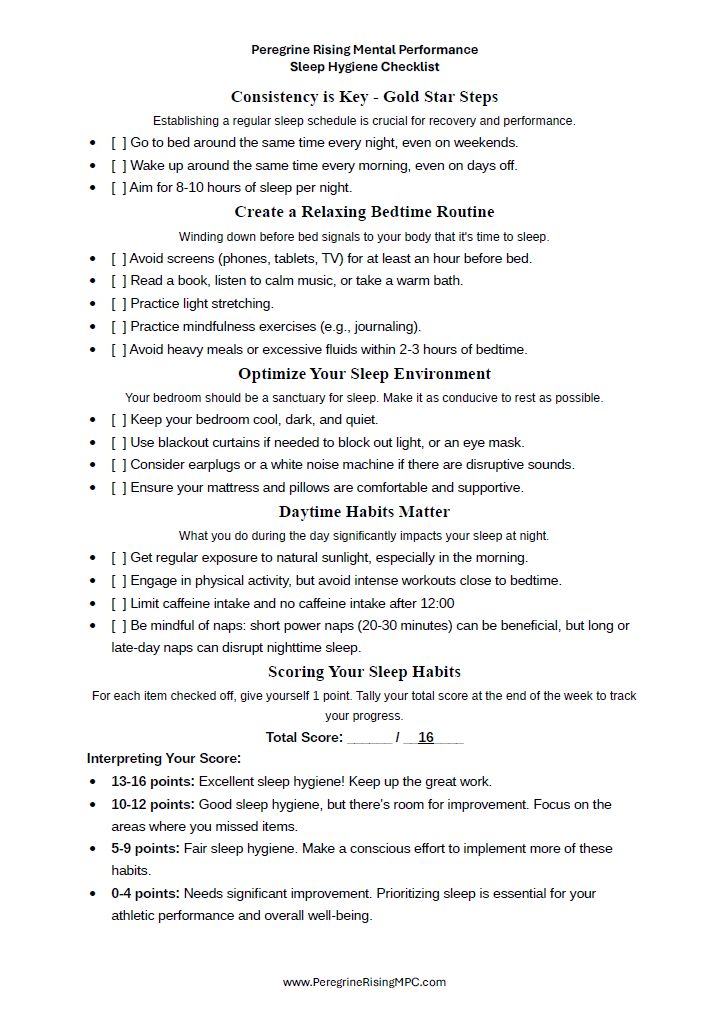
One of the biggest improvers of physical and mental performance is good quality and consistent sleep. Telling an athlete to “go sleep better” isn’t helping unless there is actionable guidance. This checklist is a simple checklist that athletes can print out and use to quantify the steps they take to support their sleep. By tracking this score they can have quantitative data to see how their habits have changed and how they have been benefiting performance and recovery.
This is a gree resource to help you, or your athlete(s). When you hit Add to Cart you will go through the usual purchasing process but be offered a secure method for downloading this resource.
References
Fullagar, H. H. K., Vincent, G. E., McCullough, M., Halson, S., & Fowler, P. (2023). Sleep and sport performance. Journal of Clinical Neurophysiology, 40(5), 408–416. https://doi.org/10.1097/WNP.0000000000000638
Gwyther, K., Rice, S., Purcell, R., Pilkington, V., Santesteban-Echarri, O., Bailey, A., & Walton, C. C. (2022). Sleep interventions for performance, mood and sleep outcomes in athletes: A systematic review and meta-analysis. Psychology of Sport and Exercise, 58, 102094. https://doi.org/10.1016/j.psychsport.2021.102094
Institute of Medicine Committee on Military Nutrition Research (2001). Caffeine for the sustainement of mental task performance: Formulations for military operations. National Academies Press (US), Washington, D.C.
https://www.ncbi.nlm.nih.gov/books/NBK223808/
Mah, C. D., Mah, K. E., Kezirian, E. J., & Dement, W. C. (2011). The effects of sleep extension on the athletic performance of collegiate basketball players. Sleep, 34(7), 943–950. https://doi.org/10.5665/SLEEP.1132
Vitale, K. C., Owens, R., Hopkins, S. R., & Malhotra, A. (2019). Sleep hygiene for optimizing recovery in athletes: Review and recommendations. International Journal of Sports Medicine, 40(8), 535–543. https://doi.org/10.1055/a-0905-3103
Vlahoyiannis, A., Aphamis, G., Bogdanis, G. C., Sakkas, G. K., Andreou, E., & Giannaki, C. D. (2021). Deconstructing athletes' sleep: A systematic review of the influence of age, sex, athletic expertise, sport type, and season on sleep characteristics. Journal of Sport and Health Science, 10(4), 387–402. https://doi.org/10.1016/j.jshs.2020.03.006
Walsh, N. P., Halson, S. L., Sargent, C., Roach, G. D., Nédélec, M., Gupta, L., Leeder, J., Fullagar, H. H. K., Coutts, A. J., Edwards, B. J., Pullinger, S. A., Robertson, C. M., Burniston, J. G., Lastella, M., Le Meur, Y., Hausswirth, C., Bender, A. M., Grandner, M. A., & Samuels, C. H. (2021). Sleep and the athlete: Narrative review and 2021 expert consensus recommendations. British Journal of Sports Medicine, 55(7), 356–368. https://doi.org/10.1136/bjsports-2020-102025