Understanding Priorities with the Hourly Inventory
This is one of my favorite drills for helping athletes to understand their stated priorities vs their lived priorites. What they say and what they do can have a cavern of difference because they don’t truly understand where their time is going. I often hear things like, “I want to spend more time doing ____, but there just isn’t any time to do it.” When we dig into it we see that they are actually prioritizing things like social media, or other distractions, over their stated priorities. I use a very simple drill to establish this point and as long as athletes are honest with themselves while completing the inventory, their eyes are really opened.
If you want to understand your lived priorities, one of the most effective things you can do is conduct an hourly inventory. For one day, or ideally, an entire week, write down what you are doing during each hour of the day. Be honest. Record the time you spend training, studying, working, sleeping, recovering, spending time with friends and family, scrolling through your phone, and everything else that fills your day. If you notice that you jump through multiple tasks in a single hour then break it down into 30 minute blocks or even 15 minute blocks.
Don't change your behavior just because you're tracking it. The purpose is to observe your current habits, not to put on a performance for yourself. At the end of the day, review your inventory and compare it with the priorities you identified. If you say athletic development is a priority, how much time did you dedicate to purposeful training, skill development, and recovery? If academics are important, how much time did you spend studying? If you value your relationships, did you intentionally make time for the people who matter to you?
You may discover that the way you spend your time doesn't align with what you say matters most. That's not necessarily a sign of laziness or a lack of commitment. You may have underestimated how long certain responsibilities take, allowed distractions to consume your free time, or failed to plan for the demands of your schedule. You might also discover that you are prioritizing one area of life at the expense of another. As I have mentioned many times in past posts, self-awareness is the foundation of performance development, this is another way to become aware of what you think your priorities are and what you demonstrate your priorities are. This inventory helps you identify these patterns before you can address them.
What Can an Hourly Inventory Teach You?
1. It reveals the difference between intention and behavior.
We tend to remember the things we believe we should be doing more clearly than the things we actually do. Tracking your time provides a more objective picture of your daily habits. As long as you are honest with yourself, this exercise can be eye opening and allow you to make actionable decisions moving forward.
2. It identifies opportunities for improvement.
You may not need to find more time to accomplish your goals. You may need to use some of your existing time differently. This inventory can reveal opportunities to reduce distractions, improve scheduling, or make better use of short periods between commitments. If you want to get into the nitty gritty of phone use, many phones have “phone use” apps within the phone that can show you the usage of each app. You might be surprised that social media plays a big role, but that you also spend a lot of time doing random tasks on your phone as well.
3. It helps you recognize when your expectations are unrealistic.
Sometimes the problem isn't poor time management. You may genuinely have too many demands competing for your attention. An inventory can show you when you need to adjust your expectations, communicate with your coach, or reconsider your commitments. School, work, commuting, physical training, meal prep, adequate sleep (7-9 hours), and recovery methods (stretching, physical therapy, etc.), might not allow you to do all the things you want to be doing. You need to look at your list of priorities and decide what is the most important for the use of what time you have.
4. It reinforces accountability.
It's easy to say you will make something a priority next week. It's harder to ignore a pattern when you can see how you spent your time over the last seven days. The inventory gives you something concrete to review and use when making adjustments. Remember that time alone doesn't tell the whole story. One hour of deliberate skill practice may be more valuable than two hours of unfocused training. Sleep and recovery may be priorities precisely because they involve stepping away from work. The objective isn't to maximize productivity every minute of the day; it's to determine whether your time reflects your values, responsibilities, and goals.
After completing your inventory, ask yourself three questions:
What does my use of time tell me about my actual priorities?
What changes would bring my daily habits into better alignment with my stated priorities?
What is one change I can implement this week?
You don't need to track every hour forever. Use the inventory as a periodic assessment, particularly when your schedule changes, your performance plateaus, or you feel as though you aren't making progress despite working hard. Awareness gives you the information you need to make deliberate changes. If you are a coach I would recommend having each athlete fill out this inventory after the first month of practice when they have established habits but are still earlier enough in the season to make changes that will impact their performance during the rest of the season.
Establish Your Priorities: The Weekly Priority Check
Understanding your current habits is only the first step. The next is deciding what you want to do differently and establishing a system that helps you follow through. What kind of mental performance coach would I be if I only helped you see the problems but didn’t offer any solutions or ways to continue forward? If possible, use the following exercise at the beginning of each week. Set aside five to ten minutes to identify what matters, turn those priorities into actions, and establish how you will hold yourself accountable. If you have an accountability partner, a teammate your trust, a best friend, a significant other, share your priorities with them. Fair warning, if you have a significant other and they are not listed high on your priority list, you might want to share it with someone else to hold you accountable.
Grab your journal and let’s get started.
Step 1: Identify Your Values
What three to five values do you want to demonstrate this week? Choose values that reflect the kind of athlete and person you want to become. Examples might include discipline, integrity, teamwork, courage, growth, or balance. Remember that values are demonstrated through behavior. Identify what each value looks like in practice rather than simply writing down words that sound good. I recommend writing a definition about what your mean for each value. For example, if you listedn “Leadership", that could be lived out in a number of ways. You might value being a leader outside of leadership positions by acting right, encouraging, and being a self-starter while leading from the back. You might also mean that you value being in a named leadership position and leading from the front. Make sure you define what you mean.
If you need assistance with defining your values, you can download the values worksheet for free here.
Sunday night journal prompt: My top three values for this week are:
Step 2: Identify Your Top Priorities
What are the three most important priorities in your life right now? Consider your athletic development, academics or work, recovery, relationships, and personal growth. Your priorities may change depending on your season, responsibilities, and circumstances. King Solomon in the book of Ecclesiastes tells us that there is a time for all things. When you are in season, out of season, on break from school, or working, your priorities are always going to be changing. If you have a major test this week then your study time might move up your priority list. If tryouts are a month away and you know you have a skillgap that needs to be filled before day 1 of tryouts, skill development might be your top priority. I recommend looking ahead over the next month to see what is on the horizon that needs to start being prioritized today.
Sunday night journal prompt: my top three priorities this week:
_________________________________
_________________________________
_________________________________
Step 3: Turn Priorities Into Actions
For each priority, identify at least one specific behavior you can schedule or complete. Instead of writing "improve my recovery," you can write "follow my planned bedtime on school nights." Instead of writing "be a better teammate," write "give constructive encouragement to a teammate at every practice." Be precise but you don’t need to be overly precise. If increasing your step count is a priority, you might not want to list “take 9,734 steps each day.”
Sunday night journal promt: what I will do this week:
Priority 1: ______________________________________
Priority 2: ______________________________________
Priority 3: ______________________________________
Step 4: Anticipate Obstacles
What might interfere with your plans? Just like with our SMART-C method of goal-setting, we need to think about contingency planning. What hurdles can hinder my ability to prioritize the things that are a priority to me? Consider fatigue, unexpected assignments, competing commitments, distractions, or changes to your training schedule. Use an if-then plan to decide how you will respond. This is the time for contingency planning to have plans in place to stay on track.
For example: If bad weather rolls in and the field is not able to be used, I will do my training at the local YMCA. If an unforseen assignment is given during the week by my teacher, I will communicate with my coach about this requirement and plan alternative methods and times to meet the training goals for the week.
Sunday journal prompt: my likely obstacle and planned response:
Step 5: Establish Accountability
Decide how you will evaluate your progress, if you don’t know how it is going then you wont know what needs to be fixed. You might review your calendar each Sunday, complete an hourly inventory for a day, check in with a coach or teammate, or keep a simple record of the behaviors you committed to practicing. This is where the accountability partner comes in and having someone that you trust to tell you the truth rather than just being overly polite is a key to success. My Mom, God bless her, always told me “great game” even when I knew I struggled on the ice. If I wanted actual feedback I knew I could trust my brother to be honest and he would have recommendations from what he saw. This is what you need in an accountability partner. “Your stated priorities didn’t match your lives priorities, great job on your castle in Clash of the Clans, but the distraction is showing in practice. How about deleting the app for the next week to see if your performance changes?”
At the end of the week, sit does and discuss these questions with your accountability partner, or at the very least, write them out in your journal.
Saturday journal prompts:
Did my actions reflect my stated priorities?
What went well?
Where did I fall short of my intentions, and why?
What needs to change next week?
Your Priorities Are a Practice, Not a Finish Line
As athletes, coaches, and professionals, we spend a tremendous amount of time working toward goals. We measure times, scores, statistics, rankings, and personal records. Those measures can help us evaluate performance, but they don't tell the whole story. The person you become while pursuing those goals matters, too. Learning to establish priorities requires more than deciding what is important. It requires examining our behavior, making deliberate choices, and accepting responsibility for the way we use our time and energy.
You won't always get it right. Your circumstances will change. You will occasionally make decisions that don't align with your intentions. What matters is your willingness to recognize those moments and make adjustments, what matters is holding yourself accountable and being willing to make the changes that need to happen.
Start with two simple actions: conduct an hourly inventory to understand how you currently spend your time, then complete the Weekly Priority Check to decide how you want to spend it moving forward. Repeat the process when your circumstances change or when you need to reassess your direction. You don't need to overhaul your entire life overnight. You need to begin making deliberate decisions that reflect the person you want to become. Success isn't just about achieving the things you want. It's also about deciding what matters, living in accordance with those decisions, and becoming someone you can be proud of along the way.
If you are interested in working with Coach Tyler, reach out using one of the contact forms on the website and let’s start the conversation and get you where you want to be. You can also download the Hourly Inventory worksheet through the link below for free.
Coach Tyler
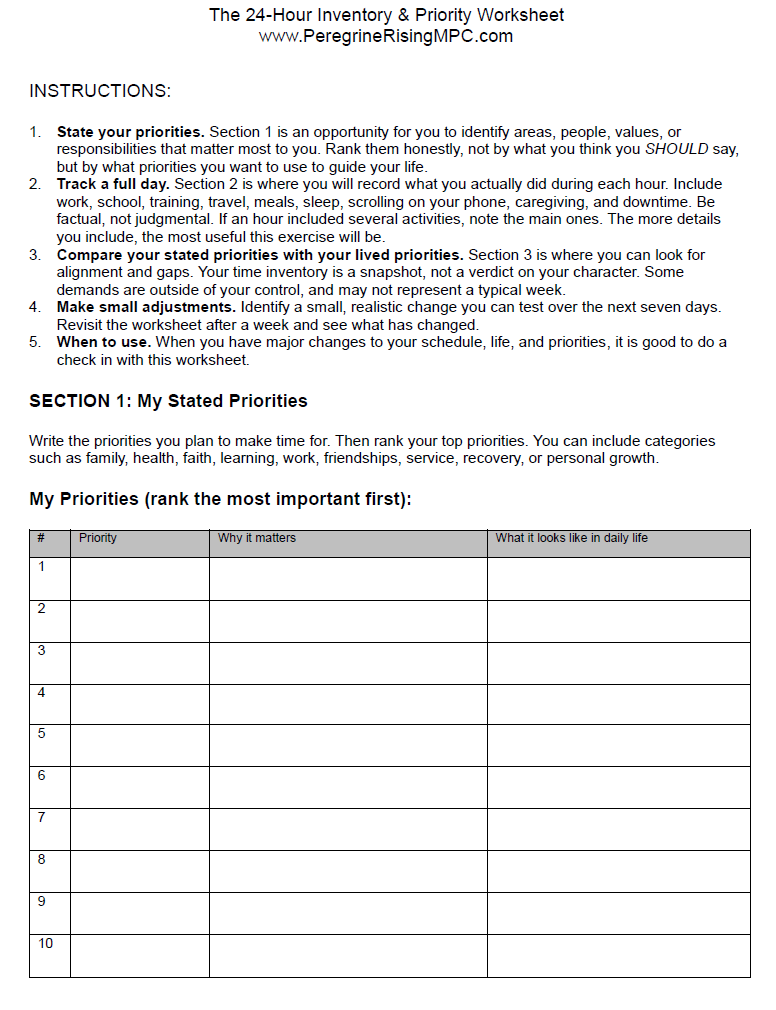
Stated priorities don’t always line up with lived priorities. Sometimes we understand the choices we are making are hindering our goals, but many times it isn’t so clear. This is a simple worksheet to help you define your priorities and then compare them to your lived priorities through a 24-hour inventory. Make sure you take time to work through the journal prompts at the end to reflect and make the right changes.