
The Top 5 Mental Performance Skills to Help You Keep Your New Year’s Resolution
Every year begins with strong intentions. Goals are set, habits are planned, and motivation is high. Yet most New Year’s resolutions don’t fail because people lack desire, they fail because people lack the mental skills required to sustain change. They fail when hurdles and obstacles get in the way and there aren’t plans in place to overcome them, those obstacles become an opportunity to return to their pre-resolution norm.
Mental performance training focuses on the skills that allow individuals to follow through when motivation fades, stress increases, or life becomes busy. Whether your resolution involves fitness, career growth, performance, or personal development, these five mental performance skills will help you maintain momentum and turn intention into consistency. I know you are bombarded with countless “New Year-New Me” articles, so I will keep this short so you can take the information and immediately apply it to your life.
1. Set Appropriate, Process-Based Goals
The most important skill for maintaining any resolution is effective goal setting.
Many people focus only on outcomes such as, losing weight, improving performance, or achieving a specific result. While outcomes provide direction, they do not guide daily behavior. Mental performance emphasizes process-based goals: goals that focus on actions you can control every day. These actions offer a stair-step method of reaching your major outcome goals.
Instead of “I want to be better,” focus on:
What will I do daily or weekly?
What behaviors move me closer to this goal? What proccesses do I need to put in place to change how I act/perform?
What does success look like today? What is today’s victory?
Clear, realistic, and controllable goals reduce overwhelm and increase follow-through. I use the SMART-C format with my athletes and business professionals. This is a simple method to make sure that your goals fit appropriately for your journey and you prepare yourself for unforseen problems.
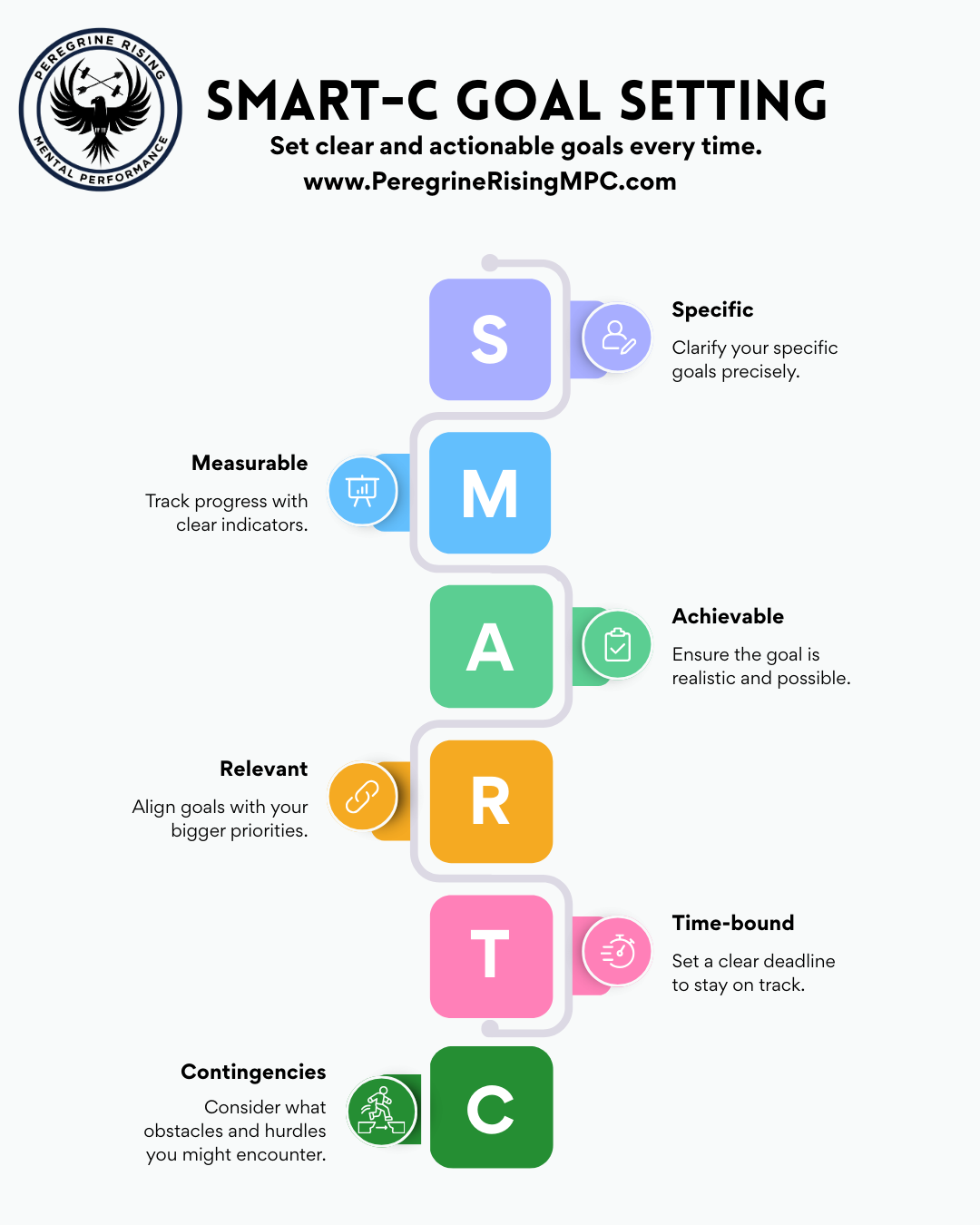
SMART-C goals offer a guideline for creating goals while also preparing for potential and unforseen obstacles.
2. Develop Self-Awareness
Change begins with awareness. Mindfulness training has been all the rage in recent years without anyone truly explaining what it is. Is it meditation, is it learning to balance, is it chanting mantras and reading self-help books? No. It is learning to be present with yourself and aware of the signals your body is giving you. It is learning to focus in on the small cues your body is sending BEFORE major changes happen.
Self-awareness allows you to recognize:
When motivation is dropping
When stress or fatigue is increasing
When old habits are creeping back in
When your body is ready, or not ready, to make a major move that day
What your body needs to get motivated based on its current state
Without awareness, people react too late. With awareness, they can adjust early. Simple tools like journaling, daily reflection, or mindful check-ins (“what am I feeling right now?”) help identify patterns before setbacks occur.
The more aware you are, the more proactive your behavior becomes.
3. Build Consistent Routines
Motivation is unreliable. Some days you have it, some days you dont. Routines are not. Routines give you ownership of a situation, even when you are somewhere new. Routines also offer consistency and opportunity to develop habits and internalize the new habits.
Mental performance training emphasizes creating systems that support behavior regardless of how you feel. Routines remove decision fatigue and create predictability—two critical factors for habit formation.
Effective routines:
Occur at the same time each day
Are simple, predictable, and repeatable
Support your energy, focus, and recovery
Can offer accountability
Consistency beats intensity any day of the week. A routine done at 70% effort consistently will outperform a perfect routine done sporadically.
4. Learn to Manage Stress and Emotional Discomfort
Discomfort is part of growth. When we are faced with adversity, we learn what strengths we possess and truly how strong we can be.
As new habits develop, stress, frustration, and self-doubt are normal. Mental performance skills such as breathing techniques, emotional regulation, and cognitive reframing help prevent these moments from becoming reasons to quit.
Instead of asking, “How do I avoid discomfort?” ask:
How do I respond to discomfort effectively?
How do I stay committed when it feels hard?
Learning to regulate stress keeps short-term emotions from overriding long-term goals. A great place to start is learning how to breath appropriately to control your stress levels. Learning to use belly breathing and resonate breathing are key for controlling your levels of stress and anxiety to a manageable level. To start with resonate breathing, work to take 6 breaths a minute while being aware of your body’s signals.
5. Practice Reflection and Adjustment
Progress requires feedback. In the military, we often used an After Action Review (AAR) to walk through a mission/training event by phase and talk about how something went and how it could have gone better, or what went great and needs to be continued.
Mental performance emphasizes regular reflection, not self judgment. Reflection allows you to evaluate what’s working, what’s not, and what needs to change without labeling yourself as a failure. When we learn to see set-backs as learning opportunities, rather than failures, we can move further into having a growth-mindset.
Ask yourself at the end of each day and at the end of each week:
What went well?
What challenged me?
What small adjustment can I make moving forward?
What skills/strengths do I have that I did not realize I had before?
This skill turns setbacks into learning opportunities and keeps resolutions alive rather than abandoned.
Resolutions Are Sustained by Skills and Consistency, Not Motivation
New Year’s resolutions don’t fail because people are weak. They fail because people rely on the motivation of a moment instead of training their mindset for the longer journey.
By developing these five mental performance skills: goal setting, awareness, routines, stress management, and reflection, you give yourself the tools needed to sustain change long after the excitement of the new year fades.
Real growth isn’t about starting strong. It’s about staying consistent.
You got this, I believe in you and believe that you can reach your goals this year.
Have a happy 2026 and may God bless you and your family this year.
~ Dr. Ty